One Wallet Connection, Twenty-Seven Countries.
The European Digital Identity Wallet lets a customer confirm one chosen fact about themselves without revealing everything else. IDENTT Vision handles the communication with every EUDI wallet through a single integration.
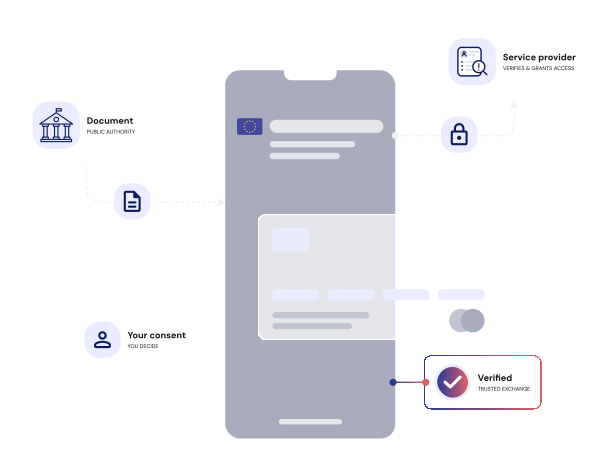
Why acceptance runs through us
Ask for less, learn enough
A wallet can confirm a customer is over eighteen, or resident, without disclosing the date or the address behind it.
- Attribute-only requests supported
- Less personal data in your systems
- Proof signed by a trusted entity
One connection to the whole ecosystem
Each member state will issue its own wallet. That variation is ours to absorb.
- One integration across the ecosystem
- Certificates and trust lists handled
- One communication standard kept, whatever changes in the wallets
A path for customers without one
Adopting new solutions will take years. Every other verification route stays available in the same session.
- National identity apps supported
- Chip reading from card or passport
- Document capture as the fallback
What is the European Digital Identity Wallet (EUDIW)?
In recent years, proving who you are online has meant handing over every piece of data on your identity document.
EUDIW reverses that. Every member state must offer citizens a digital wallet that gives them full control over what information they share. The organisation receiving the data can verify it automatically, electronically and reliably.
You are the relying party. We are the intermediary.
Accepting and supporting wallets means registering with national trust lists, holding the right certificates and staying compatible with the wallets of twenty-seven states. That is our job. Yours is making use of what a digital identity wallet brings.
What we provide
The European Digital Identity Wallet lets a customer confirm one chosen fact about themselves without revealing everything else. IDENTT Vision handles the communication with every EUDI wallet through a single integration.
One integration, every state
One connection reaches the wallet ecosystem, instead of one build per member state and one rebuild per change.
Certificates administered
Registration and access certificates obtained, held and renewed, so your entry on the trust lists stays valid.
Protocols kept current
Presentation and issuance protocols track the specifications as they change, without a release on your side.
Credential formats handled
Selective-disclosure tokens and mobile document formats parsed into one structured response for your backend.
Attributes cross-checked
Wallet data is checked against the document, the chip and what you already hold, rather than trusted on sight.
A fallback in the same flow
A customer without a wallet is routed to the other ways of confirming their identity, within the same session.
How the acceptance works
Nine things a relying party has to get right to accept a European wallet, and who does each of them.
A single entry point
One connection to the ecosystem rather than one integration per national wallet.
Registration certificates
Your organisation on the national trust lists, with the attribute scope you are permitted to request.
Access certificates
The credentials that let a request authenticate against a live wallet, administered and renewed for you.
Presentation protocol
The request and response exchange with the wallet, tracked against the specification as it moves.
Issuance protocol
The path by which attestations reach a wallet, supported alongside presentation rather than after it.
Credential formats
Selective-disclosure tokens and mobile document formats, parsed into one structured response.
Attribute cross-checks
Wallet attributes compared against document, chip and the data you already hold on the person.
Fallback methods
A national app, a chip read or a document check when a customer has no wallet yet.
The evidence record
What was requested, what was released, when, and under which certificate, kept for audit.
Three things you can ask for
| Feature | Attribute only | Identity data | With attestation |
|---|---|---|---|
| Name disclosed to you | Not included | Included | Included |
| Date of birth disclosed to you | Not included | Included | Included |
| Document number disclosed | Not included | Included | Included |
| Signed by the issuing authority | Included | Included | Included |
| Issuer checked against trust lists | Included | Included | Included |
| Accepted in any member state | Included | Included | Included |
| Nothing for you to store afterwards | Included | Not included | Not included |
| Satisfies a KYC identification | Not included | Included | Included |
Questions about wallet acceptance
When does acceptance become a duty?
PID or an attestation — what is the difference?
Do we have to store what the wallet returns?
Must our IT team build wallet infrastructure?
What about customers who have no wallet?
How is the wallet data checked?


Discover the future of identity verification
Book a demo or contact us — we'll show you how IDENTT fits your onboarding.
Book a call